

One of the first questions asked by buyers in residential developments, municipal projects, public parks, and senior living communities is: How much should we budget for outdoor fitness equipment? The price of outdoor fitness equipment varies significantly. There is no fixed standard price, as the final cost depends on factors such as the type of equipment, steel thickness, anti-corrosion surface treatment, order quantity, customization requirements, and product specifications. This guide provides general factory price ranges to help you estimate your project budget during the planning stage.
Note: The prices below are estimated ex-factory reference prices only. They do not include shipping, installation, foundation work, or embedded anchor parts. The information is intended for preliminary budget planning. For an accurate quotation tailored to your project, please contact us for a detailed price list.
| Product Series | Main Value | Typical Project | Price Range |
| Street Workouts | Calisthenics body‑weight strength | Youth sport park | $1,000-$3,000 |
| Cross‑Training | Full‑body strength + cardio | Large public gym | $900-$4,000 |
| Galvanized Steel | Maximum anti‑rust durability | Coastal & municipal | $100-$500 |
| Galvanized Steel | Landscape & comfortable touch | High‑end real‑estate & scenic | $200-$500 |
| Combination Outdoor Fitness | Space‑saving multi‑user | Ordinary residential community | $1,000-$2,000 |
| Inclusive Outdoor Fitness | Barrier‑free & rehabilitation | Senior & barrier‑free park | $200-$500 |
1. Estimated Price Ranges by Outdoor Fitness Equipment Category
1. Street Workout Equipment ($1,000–$3,000)
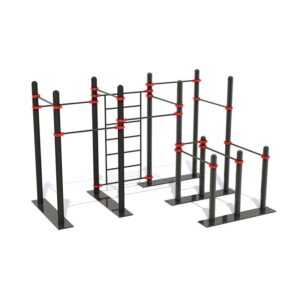
Street workout stations are outdoor fitness systems designed primarily for calisthenics and bodyweight training. They typically feature pull-up bars, parallel dip bars, monkey bars, horizontal bars, and other supporting structures. Users can perform exercises such as pull-ups, dips, hanging leg raises, L-sits, push-ups, and human flags.
Designed mainly for teenagers, fitness enthusiasts, and users with a certain level of strength, street workout equipment is widely installed in urban sports parks, youth fitness zones, skate parks, schools, and public parks. Heavy-duty steel frames provide high structural strength and durability for intensive daily use.
Key Features:
Target Users: Teenagers, fitness enthusiasts, and users interested in calisthenics and bodyweight training.
Main Equipment: Pull-up bars, parallel dip bars, horizontal bars, monkey bars, climbing frames, and other calisthenics structures.
Training Functions: Supports pull-ups, dips, hanging leg raises, L-sits, push-ups, human flags, and other calisthenics exercises.
Materials: Typically made from heavy-wall steel tubing with hot-dip galvanizing and powder coating for enhanced outdoor durability and corrosion resistance.
Key Advantages: High strength and durability, designed for intensive bodyweight training, and particularly suitable for younger and physically active users.
Applications: Urban sports parks, youth fitness zones, skate parks, schools, community fitness areas, and public parks.
2. Cross-Training Equipment ($900–$4,000)
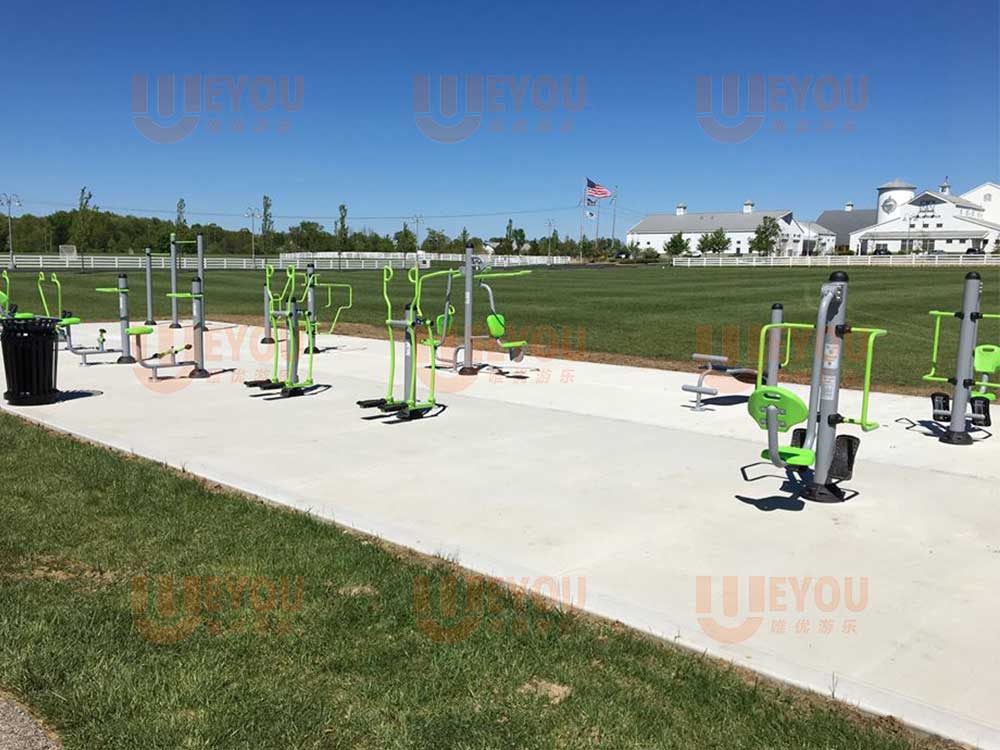
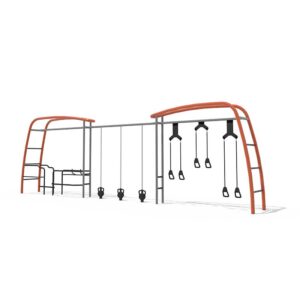
Cross-training stations provide comprehensive full-body workouts by combining strength, cardio, flexibility, and mobility training in one integrated system. Depending on the model, integrated exercise stations may include a rowing machine, chest press, leg press, air walker, waist twister, and resistance training modules.
Designed for users of different ages and fitness levels, cross-training equipment can accommodate everyone from seniors and casual users to fitness enthusiasts. It provides a balanced workout for the upper body, lower body, and core, making it suitable for public outdoor fitness areas where users have different exercise needs.
Key Features:
Core Positioning: An all-in-one outdoor fitness solution that combines strength training, aerobic exercise, flexibility, and mobility training in a single unit.
Main Functions: Rowing, chest press, leg press, air walking, waist twisting, pulling exercises, and other strength and cardio movements.
Target Users: Suitable for a wide range of users, including adults, seniors, casual exercisers, and fitness enthusiasts.
Key Advantages: Multiple exercise stations and a wide range of training functions provide a comprehensive workout experience. However, multi-station units generally require more installation space than single-function equipment.
Optional Features: Some models can be equipped with additional resistance mechanisms or adjustable resistance systems.
Applications: Large community parks, public fitness trails, outdoor gyms, residential developments, and other public fitness areas.
3. Galvanized Steel Outdoor Fitness Equipment ($100–$500)
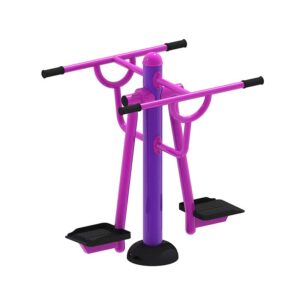
Galvanized Steel Outdoor Fitness Equipment is manufactured using a hot-dip galvanizing process followed by an outdoor-grade powder coating. This dual-layer protective finish provides outstanding corrosion resistance and superior salt-spray performance, making it ideal for coastal, rainy, and high-humidity environments.
Compared with standard powder-coated equipment, hot-dip galvanized steel offers long-lasting protection from corrosion, helping extend the service life of outdoor fitness equipment while reducing maintenance requirements.
Best Applications:
- Coastal projects
- Municipal parks and public fitness areas
- High-humidity regions
- Seaside developments
Key Features:
Core Positioning: An upgraded corrosion-resistant solution for steel outdoor fitness equipment.
Manufacturing Process: Steel tubes are first hot-dip galvanized, then finished with an outdoor-grade powder coating to provide dual corrosion protection.
Compared with Standard Equipment: Standard outdoor fitness equipment is typically powder-coated directly over steel, which may become susceptible to rust if the coating is damaged. Hot-dip galvanizing protects the steel from the inside out, making it the preferred choice for coastal and humid environments.
Advantages: Excellent resistance to corrosion, salt spray, and harsh weather conditions. Depending on the installation environment and maintenance, the service life can be extended by approximately 5–8 years compared with standard powder-coated equipment.
Disadvantages: Higher manufacturing costs and greater overall weight than standard steel equipment.
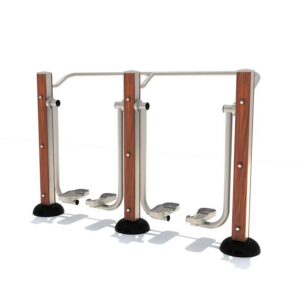
4. WPC Outdoor Fitness Equipment ($200–$500)
WPC (Wood-Plastic Composite) Outdoor Fitness Equipment combines a heavy-duty steel frame with WPC components for seats, handrails, panels, and foot platforms. It offers the natural appearance of wood while maintaining the durability and low maintenance of composite materials.
Compared with traditional all-steel equipment, WPC provides a warmer, more comfortable touch without the cold feel of exposed metal. It is water-resistant, mold-resistant, UV-resistant, and less prone to cracking, making it an excellent choice for landscape-oriented outdoor fitness projects.
Note: Although WPC is highly durable for outdoor use, it is not designed to withstand heavy impact or excessive concentrated loads.
Best Applications:
- High-end residential developments
- Scenic parks and tourist attractions
- Landscape-oriented public parks
- Resorts and recreational areas
Key Features:
Construction: Heavy-duty steel frame combined with WPC (Wood-Plastic Composite) handrails, panels, seats, and foot platforms. Some models feature additional WPC decorative components.
Advantages: Natural wood-grain appearance, comfortable touch in all seasons, waterproof, mold-resistant, UV-resistant, and less likely to crack than natural wood. It also creates a softer and more attractive visual appearance than traditional steel equipment.
Disadvantages: Higher manufacturing cost than standard steel equipment. WPC components can be damaged by severe impact and are not intended for extremely heavy concentrated loads.
Ideal Applications: Premium residential communities, scenic attractions, tourism projects, and landscape-focused parks where aesthetics and user experience are key considerations.
5. Combination Outdoor Fitness Equipment ($1,000–$2,000)
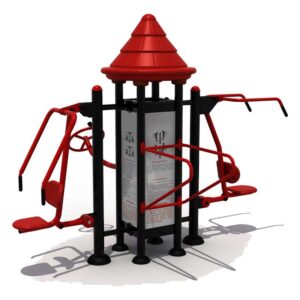
Combination Outdoor Fitness Equipment, also known as multi-station outdoor fitness equipment, integrates several exercise modules into a single central structure. Many models are equipped with a protective canopy to provide shade and improve user comfort.
A typical combination unit may include an Air Walker, Rowing Machine, Tai Chi Wheel, Seated Chest Press, Waist Twister, Leg Press, or other fitness stations, allowing multiple users to exercise simultaneously.
Compared with installing several individual machines, combination fitness equipment reduces the required installation area, foundation work, transportation, and installation costs, making it a cost-effective solution for public outdoor fitness projects. An integrated instruction panel provides clear exercise guidance and safety information for users.
Best Applications:
- Residential communities
- Community squares
- Public parks
- Compact outdoor fitness areas
- Real estate developments
Key Features:
Core Design: Multiple exercise stations are integrated into a single central frame, with many models featuring a protective canopy. Common exercise modules include an Air Walker, Rowing Machine, Tai Chi Wheel, Seated Chest Press, Waist Twister, and other fitness stations.
Advantages: Saves installation space, allows multiple users to exercise simultaneously, reduces foundation and installation costs, offers an attractive integrated appearance, and includes a centralized instruction panel with exercise guidance and safety information.
Common Configurations: Available in 3-station, 4-station, 5-station, and 6-station models to suit different project requirements.
Ideal Applications: Residential communities, community fitness plazas, public parks, schools, and other projects where installation space is limited but multiple exercise stations are required.
6. Inclusive Outdoor Fitness Equipment ($200–$500)
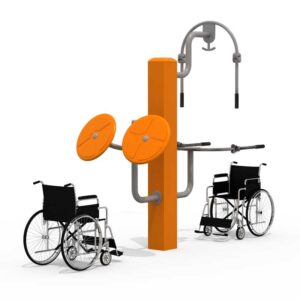
Inclusive Outdoor Fitness Equipment is designed to provide accessible exercise opportunities for users with different physical abilities, including adults, seniors, people with limited mobility, rehabilitation users, and wheelchair users.
With an inclusive and user-friendly design, these fitness stations may feature lower operating heights, wider handrails, larger grip areas, dedicated wheelchair access spaces, seated exercise stations, and low-resistance training functions. Some models are designed to allow wheelchair users to operate the equipment directly.
Inclusive fitness equipment can support upper-body rehabilitation, lower-body mobility, seated strength training, and gentle daily exercise, helping create more accessible and welcoming public fitness spaces.
Best Applications:
- Senior living communities
- Rehabilitation parks
- Nursing homes and care facilities
- Accessible public parks
- Barrier-free community fitness areas
- Municipal public fitness projects
Key Features:
Core Positioning: Inclusive fitness equipment designed for adults, seniors, people with limited mobility, rehabilitation users, and wheelchair users.
Accessible Design: Lower operating heights, wider handrails, larger grip handles, wheelchair access spaces, seated exercise options, and low-resistance training.
Training Functions: Supports upper-body rehabilitation, lower-body mobility, seated strength training, and gentle daily exercise.
Inclusive Fitness: Provides more users with opportunities to participate in outdoor physical activity, promoting accessibility and equal access to public fitness facilities.
Ideal Applications: Senior communities, rehabilitation facilities, nursing homes, accessible parks, community fitness areas, and municipal public projects.
2. Six Key Factors That Affect the Price of Outdoor Fitness Equipment
Even outdoor fitness equipment with a similar appearance can have significantly different prices. In some cases, the price difference can be as much as 2×, mainly due to the following factors:
1. Steel Thickness and Raw Material Quality
Steel thickness is one of the key factors affecting the strength, stability, durability, and cost of outdoor fitness equipment.
There is no single wall-thickness requirement that applies to all outdoor fitness equipment under international standards such as EN 16630 and ASTM F3101. The appropriate steel thickness depends on factors such as tube diameter, structural design, load requirements, installation method, and intended use.
In practice, 2.5–3.0 mm steel tubing is commonly used for many load-bearing components, while heavy-duty structures or high-load applications may require thicker tubing. Thinner tubing, such as 1.5–2.0 mm, can reduce manufacturing costs but may provide less structural strength and durability when used in demanding outdoor applications.
For this reason, buyers should consider not only steel thickness but also tube diameter, structural design, welding quality, corrosion protection, load capacity, and compliance with applicable safety standards when evaluating outdoor fitness equipment.
Tip: A thicker steel tube does not automatically mean a safer product. The overall structural design and compliance with the applicable safety standard are equally important.
2. Anti-Corrosion Surface Treatment
Different surface treatment processes can have a significant impact on the final price.
Standard Powder Coating: Lower cost and suitable for relatively dry inland environments.
Hot-Dip Galvanizing + Outdoor Powder Coating: Provides dual-layer corrosion protection and is recommended for coastal, rainy, and high-humidity environments.
Galvanized equipment typically costs 20–35% more than standard powder-coated equipment, but offers significantly improved corrosion protection and potentially a longer service life.
3. Product Series and Structural Complexity
Different types of outdoor fitness equipment require different materials and manufacturing processes.
For example:
- Single-station outdoor fitness equipment
- Multi-station street workout equipment
- WPC outdoor fitness equipment
- Inclusive outdoor fitness equipment
The more complex the structure and configuration, the greater the difference in manufacturing cost.
4. Order Quantity
The purchase quantity also directly affects the unit price.
For bulk orders of 5 sets or more, manufacturers can typically offer more competitive pricing. Small orders and sample orders generally have a higher unit cost because production, packaging, and other fixed costs are spread across fewer units.
5. Customization Requirements
Customization can increase the overall cost, including:
- Custom colors
- Logo printing or laser engraving
- Customized dimensions
- Special configurations
- Customized product structures
The more extensive the customization, the greater the additional manufacturing cost may be.
6. Additional Project Costs
The factory price is not the same as the total project cost. When preparing a complete project budget, buyers should also consider:
- Shipping and transportation
- Foundation work
- Embedded anchor parts
- On-site installation
- Rubber safety flooring
- Import duties and local taxes
- Other project-related expenses
Therefore, when comparing quotations from different outdoor fitness equipment suppliers, it is important to compare the same specifications, materials, surface treatment, configuration, and included services, rather than looking only at the unit price.
The price ranges above are for industry reference only. Every project has different requirements in terms of site conditions, equipment configuration, and purchase quantity, so it is not possible to provide a fixed price that applies to every project.
If you are planning an outdoor fitness project for a park, residential community, real estate development, or senior living facility, feel free to contact us. Simply provide us with your project location, site area, target users, and estimated purchase quantity, and our team will provide a free project layout and solution, along with a detailed quotation based on your specific requirements.
Need an Accurate Quote?
Every outdoor fitness project has unique requirements. If you’re planning a park, residential community, school, commercial development, or senior living facility, our team can provide a customized solution based on your project.
Simply send us your project location, site layout, target users, and estimated quantity, and we’ll prepare a free layout proposal and competitive factory quotation.