
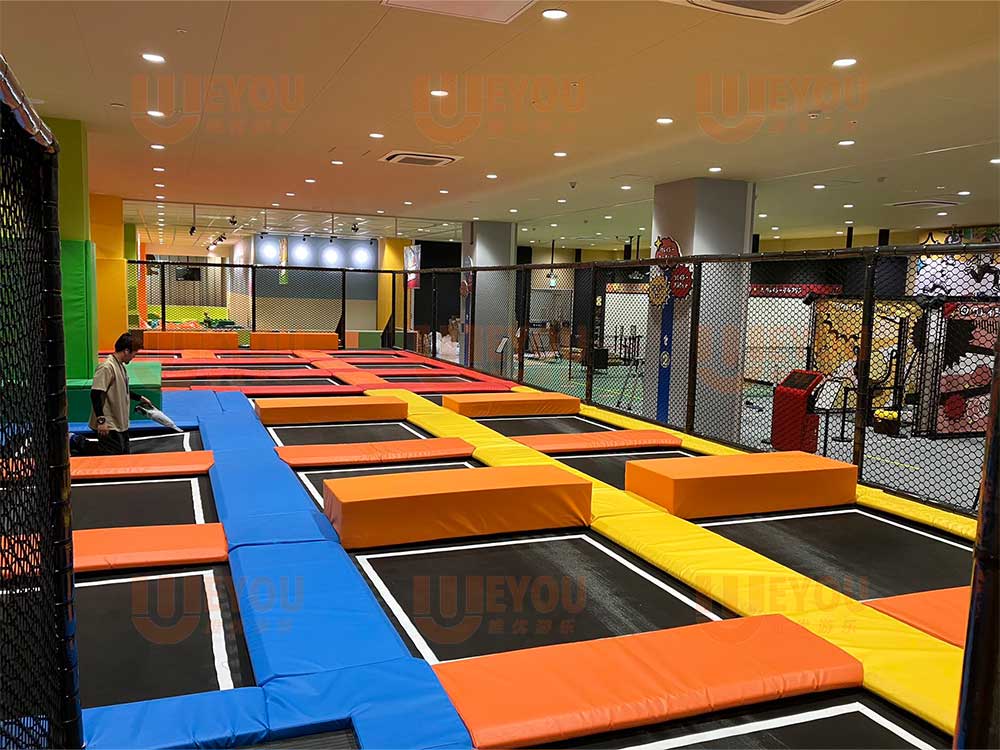
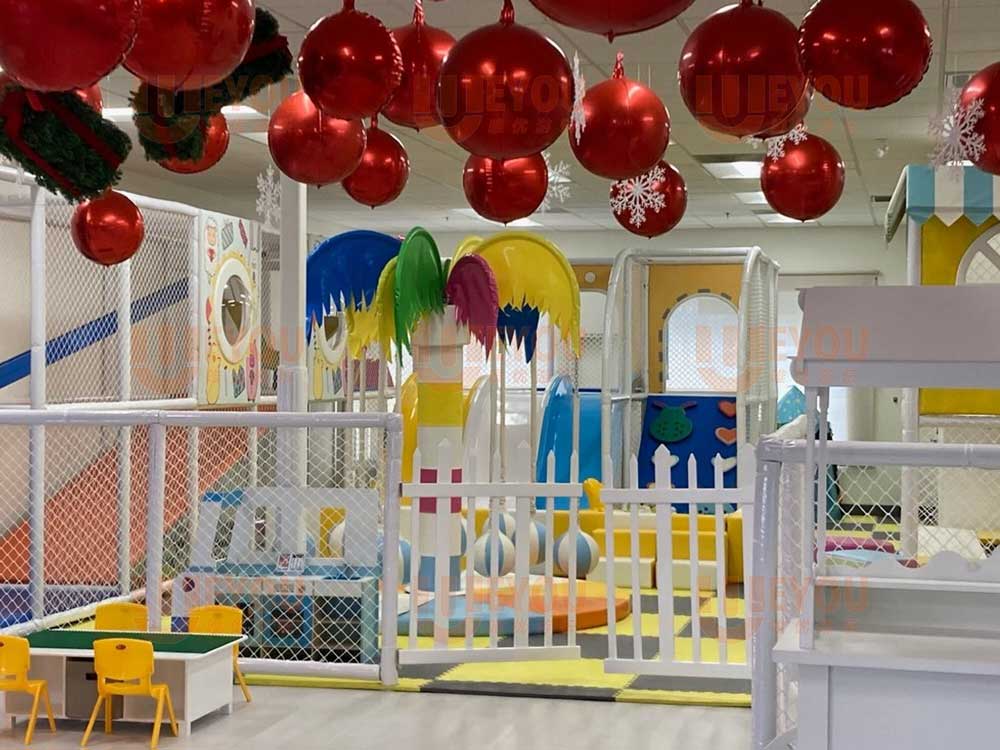
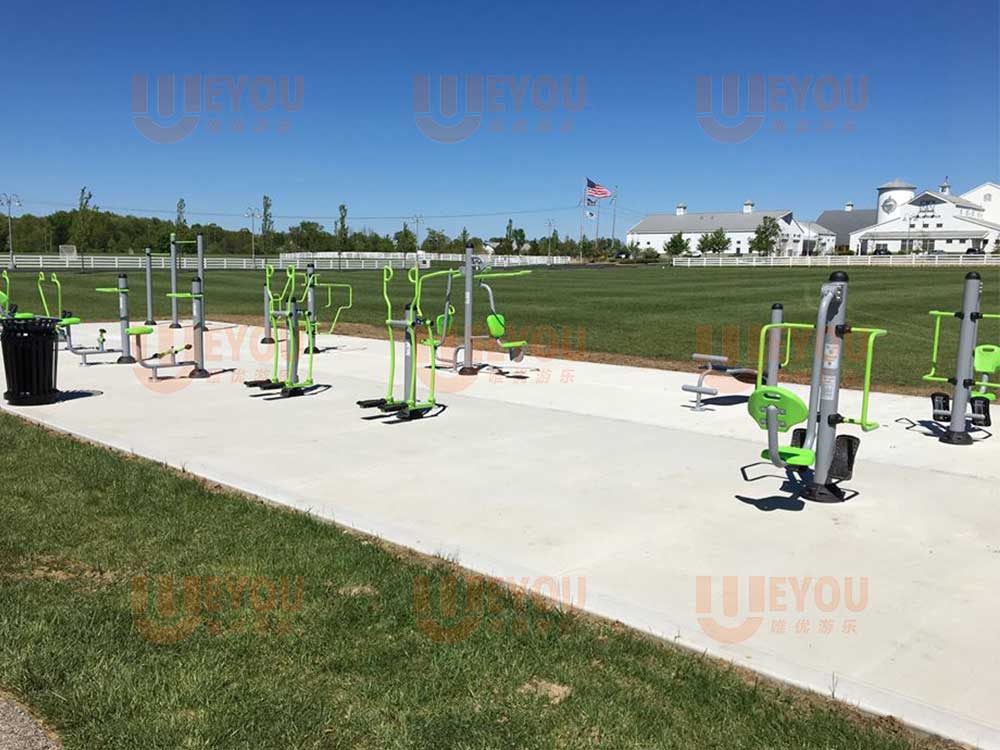
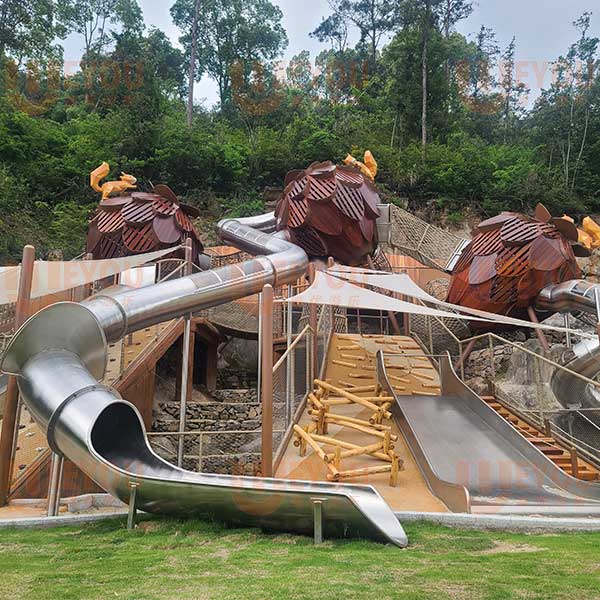
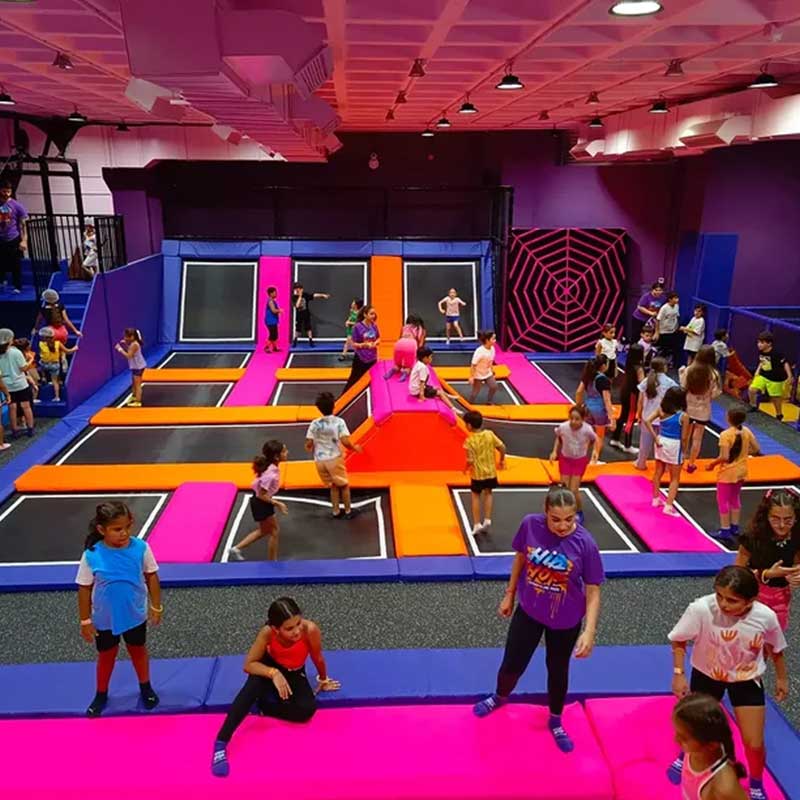

Indoor trampoline parks are very popular and continue to grow as they attract people of all ages. Whether it is adults or children, everyone likes to jump on the trampoline.They provide a healthy way to have fun with family, friends and colleague. People don’t just jump in trampoline parks – they also play games like basketball,cageball,dodgeball or climbing wall to make it even more fun and engaging for visitors.
Researches shows that the market hunger for this type of activity is high and trampoline parks are the fastest growing niche in the indoor entertainment industry.More and more people are now interested in opening trampoline parks because they are highly profitable, There is a huge potential in this business, the return on investment is quite fast, but they need meticulous planning, site selection analysis, safety and compliance, and strong operational management capabilities.it is necessary to find out in time all the essential things to get started.
Researching and planning the construction of a indoor playground involves a lot of preparatory work, such as market research on local consumption levels and scale, the number of children in the area, the competitive landscape, and subsequent site selection.
In this article, we’ll show you how to open an indoor trampoline park, covering everything from how to choose the right venue to how to plan a venue to how much the equipment costs. We will also discuss how to buy trampoline equipment and how to install and operate a trampoline. Building a trampoline park requires a passion for the park and a drive to succeed, as well as some solid business knowledge and funding to support the work. Once you see your customers smiling and your business is booming, you’ll be glad you entered the children’s play business.
1. How to Research Your Local Market?
2.How to Position Your Venue?
3. How to Choose the Right Location?
4.What Size Trampoline Park Should I Start With?
5. What Are the 3 Steps Before Confirming a Trampoline Park Location?
6. What Certificates Are Required to Open a Trampoline Park?
7.How to Plan and Design a Trampoline Park?
8. What Is the Trampoline Park Purchase Process?
9. How Much Does Trampoline Park Equipment Cost?
10.How Much Does It Cost to Open a Trampoline Park?
11.How Long Does It Take to Manufacture Trampoline Park Equipment
12.How Long Does Shipping Take?
13.How to Install a Trampoline Park?
14.How to Operate an Indoor Trampoline Park?
15.How to Market a Trampoline Park Effectively?
16. How to Maintain an Indoor Trampoline Park?
1. How to Research Your Local Market
When you start planning to open an indoor trampoline park, the first step is to research the competition within a 100-kilometer radius and analyze the surrounding population. Studying competitors helps you define your positioning if you want to operate an indoor children’s amusement business.
If there are already many similar parks in the area and the market is saturated, it may not be a suitable location, or you may need to differentiate your concept by offering a different type of product mix.
You should also check their pricing structure, including single-entry tickets and package deals, so you can use their pricing as a reference when setting your own. In addition, observe how many visitors they receive daily and the age groups of the children they attract. This will help you estimate how much revenue they may generate per week.
It is also recommended to visit these parks yourself. By experiencing them firsthand, you can identify which attractions are the most popular. You can then incorporate similar successful elements into your own park design.
In summary, the key factors to focus on are as follows.
1.1 What are their ticket prices?
1.2 How many people play each day?
1.3 What age groups are the main customers?
1.4 What attractions are most popular?
2. How to Position Your Venue
After completing market research, the next step is to define the positioning of your park. This stage is critical. Many trampoline parks face operational difficulties not because of poor equipment, but because they chose the wrong positioning at the very beginning.
Below, we outline four common types of trampoline parks for your reference. Each type has its own characteristics and target customer groups. You can combine your research findings to determine which model is most suitable for your project.
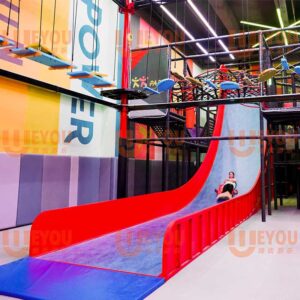
2.1 FEC (Family Entertainment Center)
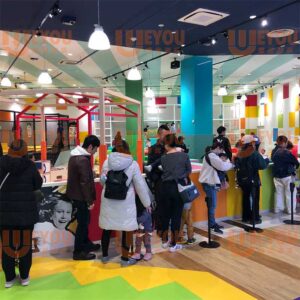
This type of venue focuses more on parent-child entertainment and supports long-term, stable operation. It is designed for families where parents and children play together. The main target customers are parents and children, so a larger space is required—typically 800 square meters or more is recommended.
The environment needs to be clean, well-organized, and safe, so parents feel comfortable allowing their children to play freely. Parents can either join the activities with their children or relax in the seating area.
The core concept of an FEC is to encourage parents to return regularly with their children. Since parents tend to stay longer, it also creates opportunities to increase revenue through additional sales such as snacks and beverages, thereby improving overall profitability.
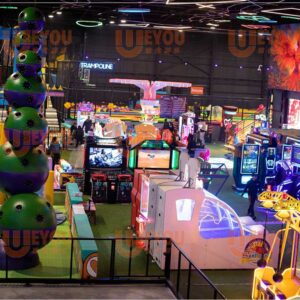
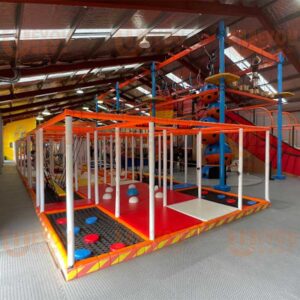
Family Entertainment Centers (FECs) aim to maximize family enjoyment by offering a wide variety of activities so that families can spend the whole day together. FECs typically include a broad range of entertainment options such as slides, climbing walls, zip lines, arcade games, rope courses, laser tag, and more.
Advantages: High repeat customer rate; parents are more likely to purchase membership cards; strong potential for hosting birthday parties.
Disadvantages: High initial investment; strict hygiene and safety requirements; difficulty in finding suitable locations.
Recommended size: 800 sqm+ (approximately 27,000 sq ft+)
Recommended age group: 1+ and parents
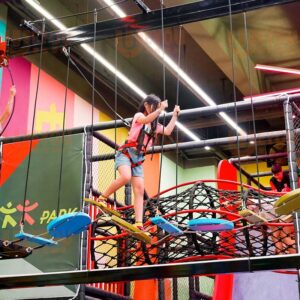
2.2 Adventure & Sports Play Center
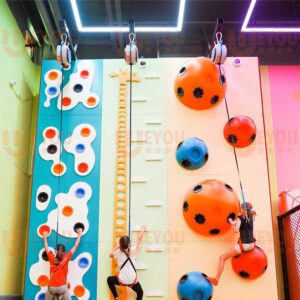
Adventure and sports play centers mainly target children aged 8 and above, teenagers, and adults. The core concept is to help participants build courage, enjoy exciting activities, relieve stress, and take on physical challenges. Starting from around age 6 and above, children gradually shift from simple play to more challenging and skill-based activities. Parents often encourage this type of play to help develop their children’s confidence and bravery. Teenagers are especially drawn to high-adrenaline experiences and enjoy pushing their limits, while adults tend to use these activities as a way to relieve work-related stress, relax, and stay physically active.
Adventure and sports play centers typically offer activities such as climbing walls, rope courses, extreme slides, roller gliders, and other challenging attractions. These experiences are designed to be adventurous, engaging, and motivating, encouraging participants to challenge themselves.
Advantages: Higher average spending per customer; suitable for corporate team-building and group activities with friends; highly shareable on social media due to visually engaging and “short-video friendly” experiences.
Disadvantages: Higher safety risks; requires more professional operational management; lower repeat visitation rate.
Recommended size: 500sqm+ ( approximately 5000 sqft +)
Recommended age group: 6+, teenagers, and adults
2.3 Trampoline Park
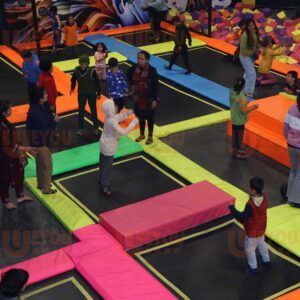
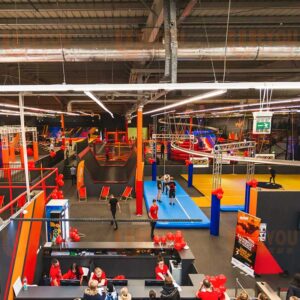
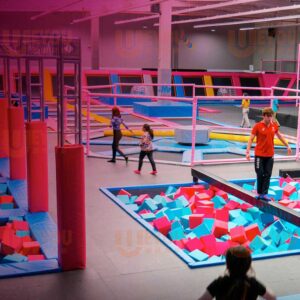
Suitable for people aged 3 and above, with almost no strict age limitations. It can be enjoyed by children, teenagers, and adults, making it a very broad and inclusive target market. The core concept of a trampoline park is physical activity and exercise. Jumping on a trampoline for 5 minutes is roughly equivalent to 15–25 minutes of jogging, while generating significantly lower impact forces on the joints, making it more joint-friendly compared to running.
Modern trampoline parks are no longer limited to jumping areas. They typically include a variety of attractions such as foam pits, air bags, basketball slam dunk zones, ninja courses, and other interactive games. This allows people to enjoy entertainment while exercising.
Advantages: Helps users achieve effective full-body exercise in a short time; improves coordination and core strength; also helps relieve stress, improve mood, and enhance sleep quality.
Disadvantages: Higher risk of sprains and injuries if not properly managed; noticeable seasonal fluctuations in demand; for indoor commercial spaces, operations may be constrained by rent costs, ventilation requirements, and fire safety regulations.
Recommended size: 500 sqm+ (approximately 5,000 sq ft+)
Recommended age group: 3+, teenagers, and adults
2.4 Soft Play Center
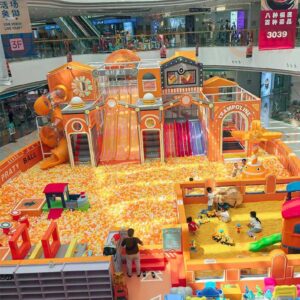
Soft play centers are comprehensive, non-powered indoor play facilities specifically designed for children aged 3–13. They integrate physical activity, cognitive development, social interaction, and sensory stimulation. The play structures typically include climbing, crawling, sliding, jumping, and other activities, which help systematically develop children’s strength, endurance, coordination, balance, and spatial awareness, while also enhancing sensory integration such as vestibular and tactile functions.
A soft play area is ideal for infants and primary school-aged children, providing a safe environment designed to stimulate the senses and encourage coordinated movement. The soft, colorful, and padded play structures allow younger children to crawl, climb, roll, and play safely, separated from older and more active children.
Soft play centers can be easily installed in various locations such as shopping malls, residential communities, and supermarkets.
Advantages: Low requirements for venue conditions; a ceiling height of 3 meters is sufficient. It can be set up in shopping malls, residential communities, and supermarkets. Initial investment is relatively low, and repeat customer rate is high.
Disadvantages: Noticeable seasonal fluctuations; business is generally weaker in winter. The target audience is relatively limited, mainly young children only. Customer traffic is highly dependent on location, requiring high foot traffic areas. There are also strict safety and regulatory requirements, including fire safety approvals.
Recommended size: 50–300 sqm (approximately 500–3,000 sq ft)
Recommended age group: Under 6 years old
3. How to Choose the Right Location
Location is one of the most important factors. The quality of the site can determine whether your business succeeds or fails. If the location is in a good area, it can significantly reduce your early-stage investment pressure. However, if the site is poorly chosen, even a large investment may not lead to success. Therefore, the first priority is selecting a good geographic location, ideally close to high foot-traffic areas.
Secondly, the site should have a regular layout, with a flat floor suitable for anchoring expansion bolts. A ceiling height of 5–8 meters is recommended, and the fewer structural columns inside, the better. Sufficient fire evacuation routes must also be reserved.
After installation, the venue must be fully equipped with fire safety equipment, including fire extinguishers, emergency lighting, and evacuation signage.
How to choose the right type of venue for your project?
Below are several mainstream venue options. You can choose the most suitable one based on local market conditions. For children’s entertainment businesses, the most important factor is not the equipment—it is foot traffic. A location inside a shopping mall is far more likely to succeed than a remote warehouse. If you choose a remote location, your equipment must be highly distinctive and extremely engaging to attract customers.
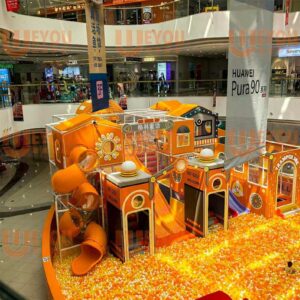
3.1 Large Shopping Malls
Shopping malls provide complete supporting facilities and naturally generate high foot traffic due to their integrated retail environment.
Which floor is suitable for an indoor playground in a mall?
Fire safety regulations place restrictions on children’s entertainment venues. In general, indoor playgrounds are allowed on floors between the 1st and 3rd levels. Floors above the 3rd level and basement levels (such as B1) may present higher fire safety risks. Therefore, it is recommended not to choose high floors (4th floor and above) or underground levels for children’s amusement centers.
3.2. How should a store in a shopping mall be decorated?
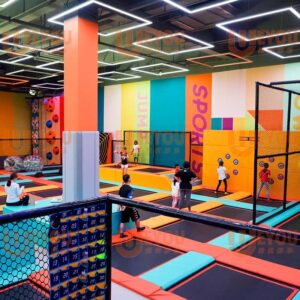
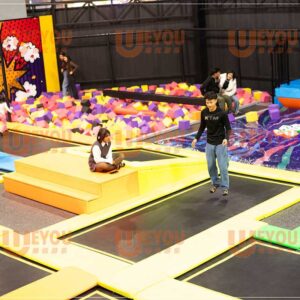
For mall-based children’s playgrounds, design and decoration are extremely important. The interior should not be too low-end in quality; instead, it should have a distinctive and unique theme to attract more customers. A well-designed and attractive environment will naturally increase customer flow and boost revenue.
Advantages: High foot traffic, strong purchasing power, convenient transportation, comfortable environment, and complete supporting facilities.
Disadvantages: High rent costs, limited space, and expensive renovation costs.
3.2 Warehouses / Old Industrial Buildings / Sports Halls
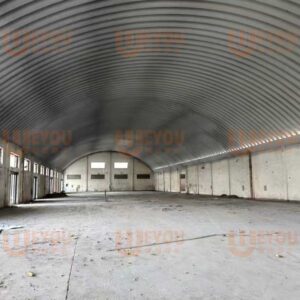
When selecting a warehouse, there are several important factors to consider. The warehouse should be spacious and well-lit. However, as a children’s amusement equipment supplier, we do not recommend blindly pursuing extremely large spaces. If the facility is too large without proper planning, it may negatively affect the overall business development.
Inside the warehouse, various materials and finished products need to be stored, so the space must be well-organized and functional to support production and installation work.
Secondly, the office area should be managed separately from the workshop or warehouse area. In addition, the main entrance must be wide enough to allow smooth access for logistics and transport vehicles.
Structural columns inside the building should be minimized, as too many columns will limit layout design and may affect both safety and the overall customer experience.
The floor should be as flat as possible. Uneven ground will slow down installation progress and increase construction difficulty. A clear ceiling height of 5.5–8 meters is recommended. The higher the ceiling, the more attractions can be installed. If the ceiling is too low, many activities cannot be included, which will significantly reduce customer experience.
Advantages: Large usable space, fewer structural columns, higher ceiling height, lower rental cost, and simpler renovation.
Disadvantages: Usually located in less central areas, lower foot traffic compared to shopping malls, and fewer surrounding supporting facilities.
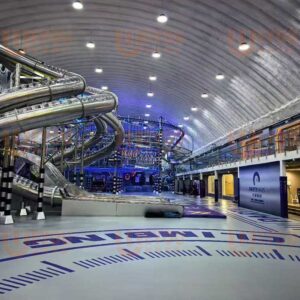
3.3 Retail Space
Retail spaces are typically small to medium-sized units, usually located in commercial districts or at the junctions of residential communities and business areas. Different locations have different commercial clusters, such as clothing markets, mobile phone malls, electronics markets, and more.
Most consumers prefer to compare products before making a purchase, and therefore tend to shop in commercial zones. If a children’s amusement park is located within or near clusters of similar businesses, it is more likely to attract customers.
For example, indoor playgrounds can be strategically located near maternity and baby stores, children’s clothing shops, toy stores, children’s photography studios, or maternal and child healthcare centers. Ideally, they should also be close to residential communities or schools, where foot traffic is concentrated and convenient.
When parents bring their children to shop for related products, they may also take the opportunity to let their children play in the nearby indoor playground.
Advantages: Convenient transportation, good location, and high foot traffic.
Disadvantages: Limited space, usually insufficient ceiling height, and high rental costs.
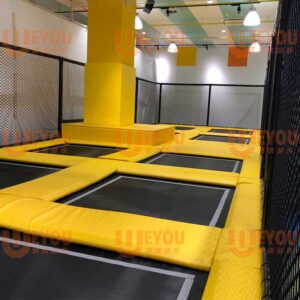
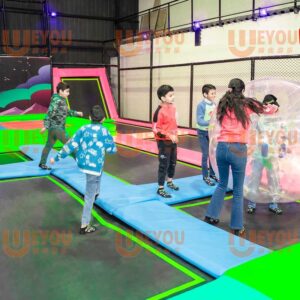
Below is a summary of the advantages and disadvantages of each type of venue.
| Location Type | Advantages | Disadvantages |
| Large Shopping Mall | High customer traffic• Higher consumer spending power• Convenient transportation• Comfortable environment• More supporting facilities | High rent• Limited space• Expensive decoration costs |
| Factory/Warehouse | Large area• Fewer columns and obstacles• Higher ceiling height• Lower rent• Simple decoration requirements | Usually located in remote areas• Lower customer traffic compared to shopping malls• Fewer supporting facilities nearby |
| Retail Space | Convenient transportation• Good location• High customer traffic | Limited space• Ceiling height is usually not enough• Expensive rent |
4. What Size Trampoline Park Should I Start With?
If this is your first investment in the indoor amusement industry, I recommend starting with a retail-style Family Entertainment Center (FEC). This model has lower risk and allows you to test the market more effectively. It is also easier to build a membership system, and most importantly, it benefits from more stable customer traffic.
Once the operation becomes mature, you can then consider expanding into a larger-scale indoor amusement park.
A very practical reality is that many large trampoline parks have closed down, while smaller, well-designed family-oriented centers are performing better. This is because the most stable revenue comes from family spending, membership programs, birthday parties, and repeat community customers.
It is important to remember that a good location is far more important than cheap rent.
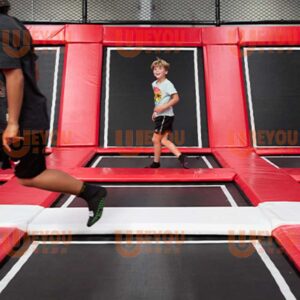
5. What Are the 3 Steps Before Confirming a Trampoline Park Location?
Step 1: Before obtaining any verbal approval, we first evaluate whether the site is suitable for an indoor amusement park. If the site is not suitable, there is no need to consult the local government, as it would only waste time.
Step 2: If the site appears to be suitable—for example, in terms of location, accessibility, ceiling height, and parking—we will analyze it further. The property owner can then consult the local government or relevant authorities to check whether approval is possible and obtain at least a preliminary verbal confirmation. If this is feasible, we proceed to the next step.
Step 3: Conduct a detailed site planning layout according to standard requirements, including fire escape routes, emergency exits, and restrooms. If the layout plan is approved, we then proceed to produce detailed construction drawings. The client can then submit these detailed drawings for formal approval.
6. What Certificates Are Required to Open a Trampoline Park?
Many investors finish the decoration work and even deliver the equipment to the venue, only to discover during the fire inspection that the emergency exits are not wide enough, the equipment does not meet European safety standards, or the products are not properly certified. As a result, the project gets stuck, opening is delayed indefinitely, rent continues to accumulate every day, and the investors become extremely anxious.
Opening a trampoline park or indoor playground usually involves several major categories of requirements, including equipment safety certification, fire safety approval, business licenses, operational management, and insurance. Requirements vary from country to country, but internationally, the following are the most commonly requested and widely recognized certifications and approvals
6.1. Business License and Venue Compliance
This is the most basic requirement. Regulations vary depending on the city and district, so before signing a lease agreement, you must check with the local government to confirm whether the venue can legally operate as a children’s amusement center and whether there are any special restrictions.
Many investors make mistakes at this stage. They sign the lease first, only to discover later that the venue is unsuitable for an indoor playground or that renovation costs are extremely high. Therefore, it is essential to confirm the permitted business scope and local regulations with the municipal authorities before proceeding further.
6.2. Fire Safety Permit
This is the most critical and also the most problematic part of the process. Many people assume that having certified equipment is enough to open an indoor playground, but in reality, the biggest challenge is usually fire safety approval.
Common fire safety requirements include:
Are the emergency exits wide enough?
Is there a sprinkler system installed?
Is emergency lighting provided?
Are evacuation signs properly installed?
Do the playground materials meet fire resistance standards?
To obtain a fire safety permit, proper planning must be completed during the early design stage. Do not wait until later to make corrections, as this can waste significant time, money, and effort.
6.3. Playground Equipment Safety Certification
Many customers ask:“Do your products have CE certification?”
In reality, CE certification alone is not sufficient for most amusement products. CE certification mainly applies to electrical products. If your indoor playground includes electrical equipment, then those electrical components must have CE certification.
If you are located in the European Union or the United Kingdom and plan to open an indoor playground, the electrical products must have CE certification, while the playground equipment itself must comply with standards such as:
EN1176
EN1176 Test Report
TÜV Certification
SGS Testing
If you are located in the United States, Canada, Australia, or the Middle East and plan to open a trampoline park, the equipment must comply with the ASTM F2970 standard. This is currently one of the most important international commercial trampoline safety standards and mainly focuses on trampoline structural safety. Most commercial trampoline parks reference this standard.
6.4. Insurance
Every business involves risks, and indoor playgrounds and trampoline parks are no exception. Trampoline parks, in particular, are considered high-risk facilities, so it is highly recommended to purchase insurance for your trampoline park to reduce potential liabilities and operational risks.
In many countries, businesses are not allowed to operate without insurance, and shopping malls may also refuse entry to tenants that do not carry proper coverage.
Since insurance is necessary, what type of insurance should you purchase?
The most important one is Public Liability Insurance. This is the core insurance coverage for trampoline parks because the biggest risks in the industry involve children getting injured, fractures, falls, or parents filing compensation claims.
Many operators only purchase equipment insurance, but in reality, the largest financial risks usually come from personal injury claims. Therefore, public liability insurance is far more important than equipment insurance.
How much coverage is required?
The insurance coverage amount for trampoline parks and indoor playgrounds mainly depends on:
The country and local regulations
The size of the venue
Whether the park includes high-altitude or adventure attractions
However, there is a commonly accepted range within the industry:
For most commercial projects, the recommended coverage is between USD 1 million and USD 5 million, depending on the country, mall requirements, and project size.
7. How to Plan and Design a Trampoline Park
After obtaining verbal approval from the local authorities, you can start contacting equipment suppliers and ask them to provide layout plans and 3D renderings. However, the supplier will need detailed dimensions and site information from you. The more detailed the information provided, the better, as this can help avoid many problems caused by incomplete site data during the later stages of design and installation.
For example, you should provide information such as:
The size and position of structural columns
Emergency exit dimensions
Entrance locations
Ceiling height
Any obstacles inside the venue
You can also share your own ideas with the supplier, such as your preferred color scheme or the attractions you would like to include. Most basic customization requests can be achieved. However, the supplier will usually determine the final layout and decide where each attraction should be placed based on safety standards and space planning requirements.
Although not all ideas may be fully achievable, many suppliers will try their best to accommodate your preferences while ensuring safety compliance. The key requirement is that you provide accurate site information.
Providing Accurate Dimensions:If your venue is very large, contains many walls and structural columns, or has a complex layout, it is highly recommended to provide an AutoCAD drawing of the site. CAD files allow suppliers to clearly understand the exact dimensions, structural layout, and equipment positioning, making later design and installation much easier.
If the provided dimensions are inaccurate, installation can become a major problem later. Installation workers may need to modify the equipment on-site, which increases labor costs and extends installation time. Delays in installation may also postpone the opening date.
If materials become insufficient due to inaccurate measurements, additional components may need to be manufactured and shipped separately. Furthermore, if the installation team travels from China, their visa duration is limited, making accurate measurements even more important.
Therefore, all dimensions provided must be accurate and carefully verified in advance.
Hand-Drawn Layouts:If the venue is relatively small and contains only a few structural columns, and if you already know the exact dimensions, ceiling height, and entrance/exit locations, you may provide a hand-drawn layout to the supplier for creating the floor plan and 3D design rendering.However, the same principle still applies:The dimensions must be completely accurate.
If incorrect measurements are provided, installation problems may still occur during the later stages.
3D Design:Before the supplier provides the layout and design, you can first tell them what style and functions you prefer for your trampoline park. If you are not sure which attractions to include, you can ask the supplier to design a layout based on your site and recommend the most popular attractions for children.
Usually, the supplier will first provide a floor layout plan, clearly indicating where each attraction will be placed within the venue. If you are not satisfied with the initial design, revisions can be made.
Once the layout is confirmed, the supplier will proceed with creating the 3D renderings. The first version will be sent to you for review, and you can discuss any necessary adjustments with the supplier.
After the 3D design is fully confirmed, the production and purchasing process will begin.
8. What Is the Trampoline Park Purchasing Process?
Before purchasing the products, you need to confirm whether you have import rights, which essentially means whether you are qualified to handle customs clearance and import commercial goods.
If you do not have import rights, what should you do?
If this is your first time opening an indoor amusement park and you do not have import rights, there is no need to worry. You can hire a local customs broker to handle clearance, which is the most common solution. You can also use a freight forwarder who offers “DDP (Delivered Duty Paid)” service, where they handle the entire process for you. Additionally, you may check whether your supplier can offer DDP terms.
If you plan to work in the playground equipment industry long-term and regularly import products from China, it is recommended to officially register a company and obtain import rights.
The purchasing process typically starts with placing an order and paying a deposit to the supplier. Usually, a 30% deposit is required, although this may vary depending on the supplier’s terms.
After receiving the deposit, the supplier begins production. Once production is completed, the remaining balance is paid. After the supplier receives full payment, shipment arrangements will be made.
You may choose to arrange shipping through your own freight forwarder, or let the supplier handle logistics for you. Once the goods arrive at your site, installation can begin.
After confirming the product design, delivery time, and production requirements with the supplier, you will proceed with placing the official order. Typically, the payment structure is:30% deposit before production,70% balance before shipment
So, how much does a trampoline park equipment cost?
9. How Much Does Trampoline Park Equipment Cost?
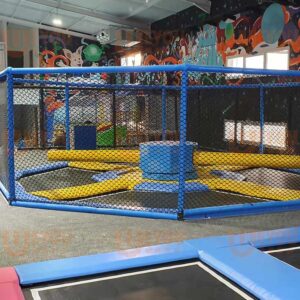
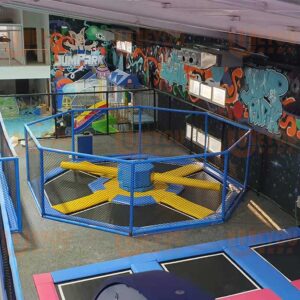
If you purchase from China, the price is generally around $80–$150 per square meter (approximately $7.5–$14 per square foot).
However, the final cost depends heavily on design complexity, attraction types, material selection, and customization level. Different layouts and features will directly affect the overall budget.
If your project size is relatively small, around 200 sqm (2,000 sq ft) to 500 sqm (5,000 sq ft), the total investment is typically around $15,000–$75,000.
For a medium-sized project of 500 sqm (5,000 sq ft) to 1,000 sqm (10,000 sq ft), the cost is usually around $40,000–$150,000.
For a medium-sized project of 500 sqm (5,000 sq ft) to 1,000 sqm (10,000 sq ft), the cost is usually around $40,000–$150,000.
For a large-scale indoor playground of 1,000–2,000 sqm, the total cost is generally between $80,000–$300,000+, depending on the number of attractions and the level of customization.
Because different designs include different functions and equipment combinations, it is difficult to provide an exact price before the design is finalized. In most cases, the final quotation can only be confirmed after the layout and 3D design are completed.
To speed up the process, you can also directly tell the supplier your budget. Based on your budget range, the supplier can adjust the design, recommend suitable attractions, and create a customized solution that fits your investment level.
In addition, factors such as installation complexity, safety certification requirements, shipping method (FOB/DDP), and local compliance standards may also influence the final cost. Therefore, a clear budget and detailed site information will help suppliers provide a more accurate and efficient proposal.
We suggest NOT: Always looking for the lowest price.Raise a red flag if you come across a much cheaper offer than others. You know, there is no lowest price in China, only lower and lower prices. The lowest price always comes with a high risk, maybe quality, quantity or reputation.
10. How Much Does It Cost to Open a Trampoline Park?
Besides trampoline equipment, are there any other costs involved? Many people think that once they pay for the equipment, there are no additional expenses. However, in reality, there are several other costs that need to be considered. Below are the additional expenses you should take into account:
Many first-time investors believe that the equipment itself is the only major expense when opening a trampoline park. In reality, there are many additional costs involved, including venue renovation, shipping, installation, insurance, staffing, and marketing.
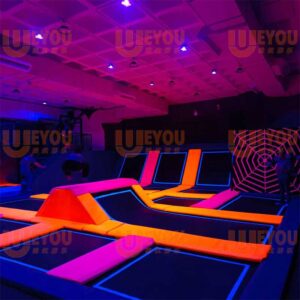
The total cost of opening a trampoline park can range from USD 50,000 to USD 500,000+, depending on the size of the facility, the attractions included, the country or region, and the level of customization.
Small Trampoline Park
Area: 200–500 m² (2,000–5,000 sq ft)
Estimated Investment: USD 90,000–300,000
Cost Breakdown:
| Trampoline Park Equipment | USD $20,000-$70,000 |
| Shipping Cost | USD $2,000-$6,000 |
| Import Duties & Taxes | USD $1,000-$10,000 |
| Installation Cost | USD $3,000-$10,000 |
| Insurance | USD $3,000-$10,000 per year |
| Staff Salaries | USD $30,000-$80,000 per year |
| Renovation & Decoration | USD $20,000-$70,000 |
| Rent | USD $30,000-$80,000 pear year |
Medium-Sized Trampoline Park
Area: 500–1,000 m² (5,000–10,000 sq ft)
Estimated Investment: USD 270,000–580,000
Cost Breakdown:
| Trampoline Park Equipment | USD $50,000-$150,000 |
| Shipping Cost | USD $3,000-$9,000 |
| Import Duties & Taxes | USD $1,500-$15,000 |
| Installation Cost | USD $5,000-$15,000 |
| Insurance | USD $3,000-$10,000 per year |
| Staff Salaries | USD $80,000-$120,000 per year |
| Renovation & Decoration | USD $50,000-$100,000 |
| Rent | USD $80,000-$160,000 pear year |
Large Trampoline Park
Area: Over 1,000 m² (10,000+ sq ft)
Estimated Investment: USD 550,000–$600,000+
Cost Breakdown:
| Trampoline Park Equipment | USD $150,000+ |
| Shipping Cost | USD $9,000+ |
| Import Duties & Taxes | USD $15,000+ |
| Installation Cost | USD $10,000-$20,000 |
| Insurance | $10,000 per year |
| Staff Salaries | USD $120,000-$200,000 per year |
| Renovation & Decoration | USD $50,000-$100,000 |
| Rent | USD $160,000+ pear year |
Important Note
The figures above are provided for reference only. Actual costs may vary significantly depending on the country, city, local labor rates, rental prices, import regulations, facility requirements, and project specifications. Before making an investment decision, it is recommended to conduct a detailed market analysis and prepare a comprehensive business plan based on your local conditions.
11. How Long Does It Take to Manufacture Trampoline Park Equipment?
Production Process: After the deposit is paid, the supplier will begin arranging production. Before manufacturing starts, the supplier will reconfirm important details with you, such as product dimensions, production requirements, and any special requests. They will usually send you the following documents for final confirmation:
- 3D design renderings
- AutoCAD drawings
- Engineering drawings
- Special production requirements
Once everything is confirmed, it is best not to make further changes. Any modifications after confirmation may affect the delivery time or increase the cost, unless the supplier has not yet started producing the section that needs to be changed.
How long does it take to produce trampoline park? under normal circumstances, the overall lead time is approximately 20–30 days.
If your project is relatively small (around 200 sqm) and the supplier is not very busy, the lead time may be around 20 days.
If your project is larger and the supplier has a heavier production schedule, the lead time is usually around 30 days.
It is important to note that this timeframe refers to the total lead time, not only the manufacturing time.
After the order is placed, the supplier does not begin production immediately. The first step is preparing the engineering drawings. Workers can only start manufacturing after the engineering department completes the technical drawings based on the approved design renderings.
For smaller projects, engineering drawings usually take around 5–7 days to complete.
For larger or more complex projects, the drawing process may take 10 days or more.
This means that if the total lead time is 30 days, around 10+ days may be spent on preparing technical drawings, while the remaining time is used for actual production and manufacturing.
12. How Long Does Shipping Take?
Shipping
After the products are completed, the supplier will request the remaining balance payment. Once the balance is paid, shipment can be arranged.
You may either:
- Arrange shipping through your own freight forwarder
- Ask the supplier to handle transportation for you
If you use your own freight forwarder, they will contact the supplier directly to coordinate the loading schedule and container arrangement.How Long Does It Take to Import from China?
Many customers are eager to receive their goods as soon as they complete payment. However, the shipping time varies depending on the destination country and region.
Below is the approximate sea freight transit time for different regions (for reference only):
- Asia: Around 7-15 days
- Oceania: Around 20 days
- Middle East: 15–25 days
- Europe: 30–40 days
- Africa: Around 30 days
- West Coast of North America: 15–20 days
- East Coast of North America: 20–30 days
- South America: 30–35 days
However, after the goods arrive at the destination port, you still need to consider:
- Customs clearance time
- Local delivery time
Customs clearance usually takes around 7 days, and local transportation to the site may take another 7 days.
Therefore, the actual delivery time is generally:
Sea freight transit time + approximately 14 additional days
This combined timeframe is usually the realistic estimate for when you will finally receive the goods at your venue
13. How to Install a Trampoline Park?
What preparations are needed before installation?
Before installation begins, the venue should be completely cleaned and the goods should be sorted and organized by category.
You should also prepare the necessary installation tools, including:
- Air pump
- Welding machine
- Cutting machine
- Hand saw
- Electric wrench
- Impact drill
- Hand grinder
If the equipment is tall, scaffolding and trestle ladders will also be required.
Installation Methods
The installation method depends on the size of your venue.
If the venue is relatively small (less than 200 sqm), self-installation is possible because the supplier will provide detailed installation drawings and videos.
If the venue is larger (more than 500 sqm), it is recommended to ask the supplier to arrange professional installers, as they are more experienced and can complete the installation faster.
Self-Installation
After the goods arrive, how should you install them?
If your project is not very large (around 200 sqm), you may install it yourself. The supplier will usually provide:
- Detailed installation drawings
- Installation videos
- Technical guidance
You can follow the instructions step by step. If you encounter problems during installation, you can contact the supplier for support and troubleshooting.
However, this requires choosing a reliable and experienced supplier who can provide proper after-sales support.
Arranging Professional Installers
If your project is large, we recommend arranging experienced installers from China because they are already familiar with the products and can install them more efficiently.
In addition, if problems occur during installation, professional installers are usually able to solve them quickly on-site.
However, additional costs must be considered, including:
- Installer salaries
- Round-trip flight tickets
- Accommodation and meals
These details should be discussed clearly with the supplier in advance.
Besides the Chinese installation team, you will usually still need several local workers to assist on-site. Depending on the project, local carpenters and welders may also be required.
The number of workers needed depends on the size and complexity of your venue.
Installation Cost
The installation labor cost is generally around:
USD 150 per day per installer(excluding flight tickets, accommodation, and meals)Please note that labor costs may vary depending on market conditions and project location.
Recommendation:
You can ask the supplier to provide a separate quotation for installation services. Then compare the total cost with hiring local workers, and decide which option is more suitable for your project.
Installation Time
Many investors want to open their trampoline park as soon as possible after receiving the equipment, because the sooner they open, the sooner they can start generating revenue. So, how long does installation usually take after the equipment arrives?
In fact, the installation time depends on several factors, such as the size of the park, the types and number of attractions included, the complexity of the design, and the number of installers working on the project.
For example, a small trampoline park may only take a few days to install, while a larger project with multiple attractions can take several weeks,even 1-2 months. Proper site preparation, equipment organization, and an experienced installation team can also significantly reduce the installation time.
Below are some estimated installation timelines for your reference:
- ≤500 sqm: around 10-20 days
- 500-1000 sqm: around 30 days
- ≥1000 sqm: 40-60 days
14. How to Operate an Indoor Trampoline Park?
Staff recruitment should begin around 3 months before opening. Key positions usually include:
- Store manager
- Safety staff
- Coaches
- Cleaning staff
- Cashiers
All employees should receive professional training before opening.
So, how many employees are needed?
For a 1,000 sqm trampoline park combined with an indoor playground, it is common to hire around 10–20 employees, depending on the attractions, operating hours, and customer traffic. During weekends and peak seasons, additional part-time safety staff may be required.
Store Manager (Recruit 3 months before opening and involve them in pre-opening operations and marketing)
The store manager is responsible for overseeing all daily operations and ensuring that operational standards are properly implemented. Their duties include:
- Managing daily venue operations
- Staff scheduling and supervision
- Handling customer service
- Monitoring revenue and operational performance
- Participating in pre-opening promotion and marketing activities
Safety Staff (Recruit around 15 days before opening and provide training)
Safety staff are assigned according to the venue size. Generally: One safety staff member for every 100 sqm is recommended.
Their responsibilities include:
- Supervising children during play
- Ensuring customer safety
- Responding quickly to accidents or emergencies
- Reminding or stopping children and parents from dangerous behavior
Additional safety staff are usually required during weekends and public holidays.
Coaches (Recruit around 15 days before opening and provide training)
Coaches are responsible for:
- Trampoline instruction and guidance
- Organizing games and interactive activities
- Providing safety instructions to players
- Performing scheduled demonstrations or shows
Their role is especially important in trampoline parks and sports-oriented attractions.
Cleaning Staff (Recruit around 15 days before opening and provide training)
Cleaning staff are responsible for:
- Daily cleaning and sanitation
- Inspection and cleaning of fire safety equipment
- Maintaining cleanliness of attractions and public areas
- Ensuring a safe and hygienic environment for customers
Cashiers (Recruit around 15 days before opening and provide training)
Cashiers are responsible for:
- Processing tickets and payments efficiently
- Politely and patiently answering customer inquiries
- Confirming daily revenue with the store manager
- Handling accurate financial records and cash management
Efficient front-desk service is very important for improving customer experience and operational efficiency
15. How to Market a Trampoline Park Effectively?
Marketing is one of the most important parts of operating a successful trampoline park. Even if your venue has great equipment and an excellent location, without effective marketing it can still be difficult to attract customers. A successful trampoline park usually combines both online and offline marketing strategies to increase brand awareness, attract new visitors, and improve customer retention.
Online Marketing
Online marketing is an effective way for trampoline parks to reach a large audience, including local families, teenagers, schools, and young adults. It offers wide market coverage, fast communication, and helps build brand awareness quickly. High-quality videos and attractive photos can capture attention and encourage potential customers to visit your park. However, businesses should also be aware that online advertising costs can be high and competition on social media platforms is often intense.
Facebook is still one of the most popular social media platforms worldwide. Create a professional business page to connect with customers, share promotions, post customer photos, and interact with your local community.
Twitter is suitable for sharing news, announcements, promotions, holiday events, and real-time updates quickly with your audience.
YouTube is the second-largest search engine in the world. Regularly uploading videos such as park tours, customer experiences, birthday parties, and trampoline challenges can help increase your visibility and attract more customers.
Instagram is one of the most popular social media platforms today. High-quality photos and short videos can effectively showcase your attractions, venue atmosphere, and customer experience.
TikTok is extremely effective for trampoline parks because exciting jumping moments and challenge videos are highly shareable. Posting fun clips, customer highlights, and trending challenge videos can quickly increase exposure and attract younger audiences.
Additional Online Strategies
- Run local Facebook and Google ads
- Encourage customers to leave Google reviews
- Offer online booking and membership systems
- Collaborate with local influencers and parenting bloggers
- Launch seasonal promotions and holiday campaigns
Offline marketing
Offline marketing is particularly important for indoor playgrounds and trampoline parks because most of their target customers live within the local community. It offers lower promotion costs, allows businesses to reach more targeted local customers, and helps build stronger customer relationships through direct engagement. Local marketing activities can increase trust, encourage word-of-mouth referrals, and drive repeat visits. However, offline marketing typically has a more limited reach than online marketing, some traditional advertising methods may be perceived as intrusive, and certain promotional activities can still require a significant budget.
Mobile Advertising
Use advertising vehicles, banners, and local signage near schools, shopping malls, communities, and busy streets to improve local visibility.
School and Educational Cooperation
Partner with schools, kindergartens, training centers, and educational institutions. You can offer:
- School group activities
- Student discounts
- Graduation parties
- Sports events
- Educational field trips
Community Marketing
Participate in local community events and family festivals. Offering free trial tickets or small games can help attract parents and children to your venue.
Birthday Parties and Membership Programs
Birthday parties and membership systems are very important for increasing repeat customers and long-term revenue. Offering attractive party packages and membership discounts can help improve customer loyalty.
16. How to Maintain an Indoor TrampolinePark
Trampoline Park Daily Inspection & Maintenance Guide To ensure the safety and long-term durability of a trampoline park, Keeping a trampoline park clean,regular inspection and maintenance of all equipment is very important for safety, customer experience, and equipment lifespan.. The following guide outlines the key areas that must be checked within the trampoline park, including structural components, jumping areas, safety systems, and cleaning requirements.
1. Trampoline Main Frame
The main frame structure must be checked regularly to ensure safety and stability. Inspect whether screws are loose in each area. Tighten all loose screws immediately. Check whether ropes in ninja course areas are split or damaged. Replace any damaged ropes promptly. Proper maintenance of the main frame ensures the structural integrity of the entire trampoline system.
2. Jumping Mats
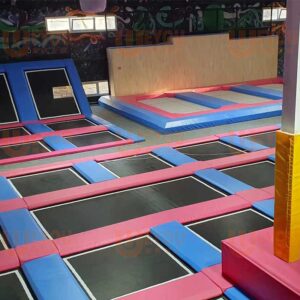
Jumping mats are one of the most frequently used components and require daily inspection. Check for scratches on the mats. Monitor whether scratches are widening or deepening. Inspect stitching to ensure it is not fraying. Replace mats if cracks or serious damage appear. Regular monitoring helps prevent accidents and ensures a safe jumping surface.
3. Safety Padding (Within Trampoline Area)
Safety padding plays a critical role in protecting customers from injury.
- Check if any sharp objects have been left by customers.
- Clean the padding regularly.
- Inspect whether the surface is damaged or broken.
- Check if stitching is loose or coming apart.
- Ensure padding is securely attached to Velcro on the frame.
If padding becomes loose or displaced, it should be repositioned or replaced immediately.
4. Springs
Springs should be inspected regularly to maintain elasticity and safety performance.
Randomly remove one spring from each side of the mat for inspection.
Check for deformation, rust, or loss of elasticity.
Replace springs if they extend more than 200mm and do not return to their original shape.
5. Foam Pit
The foam pit area must be kept clean and safe at all times. Remove all foam blocks periodically. Clean the safety padding underneath. Clean the flooring beneath the foam pit. Remove any foreign or sharp objects. This helps maintain hygiene and prevents hidden safety hazards.
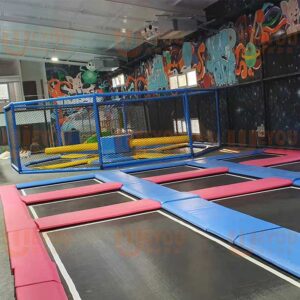
6. Fences and Netting
Fences and protective net systems ensure user safety and must be maintained carefully.
- Check whether fences are loose
- If loose, remove protective pipe covers and tighten the structure
- Inspect plastic ties for aging, cracks, or reduced strength
- Replace damaged plastic ties immediately
Proper fence maintenance ensures that users remain safely within designated play areas.
Conclusion
Regular inspection and maintenance of all trampoline park components—including the frame, mats, springs, foam pits, and safety fencing—is essential for ensuring customer safety and prolonging equipment lifespan. A well-maintained park not only reduces operational risks but also improves customer experience and overall business performance.